By Elias Vale · Published · 6 min read
In this article
In FIFA’s July 2026 session for holding midfielders, the job description is expansive: support the build-up, recognise central overloads, escape pressure and find the next pass. The number six is apparently expected to be a traffic controller with boots. Before any of those decisions comes a less glamorous question: what information has the player actually gathered?
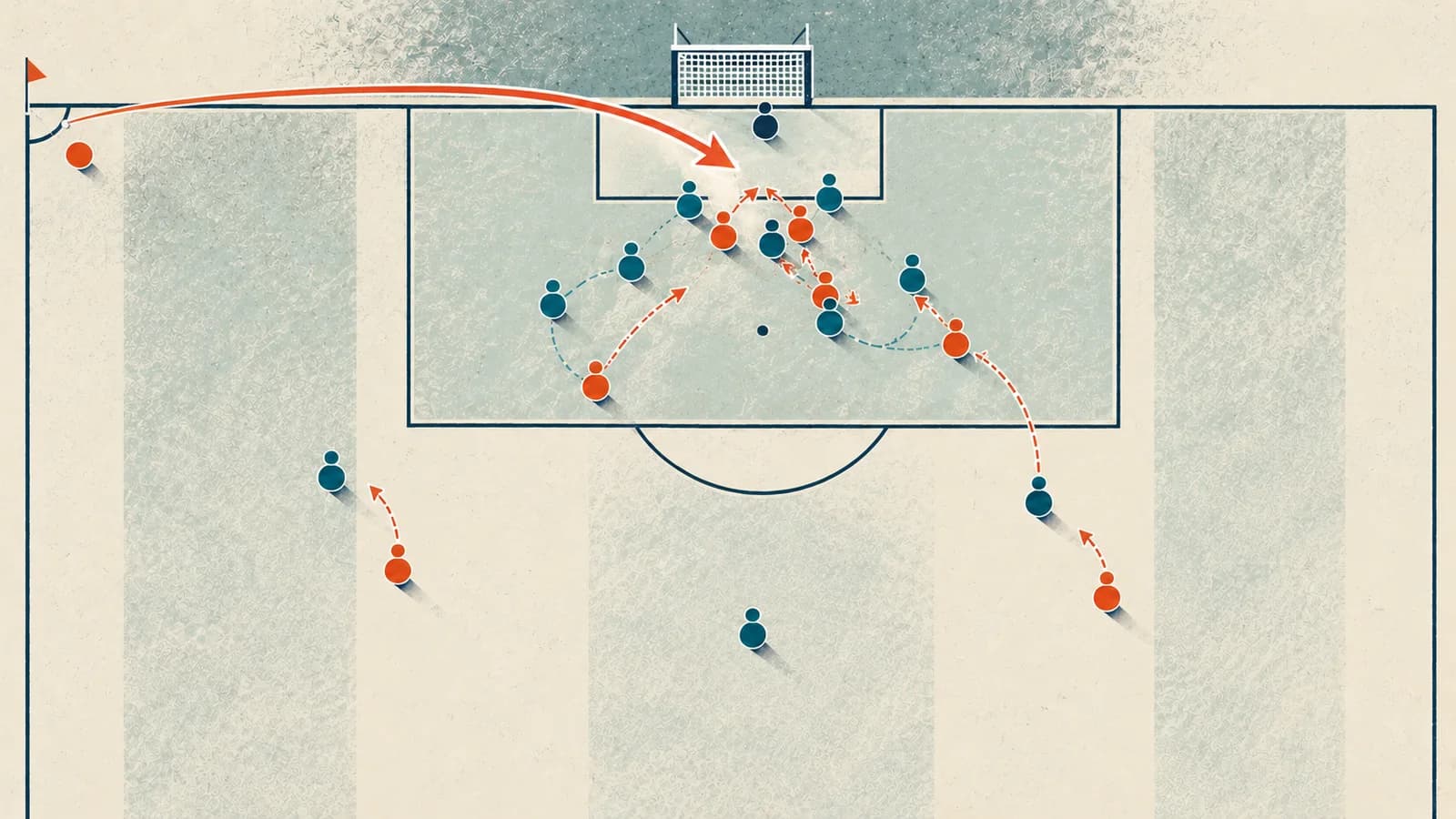
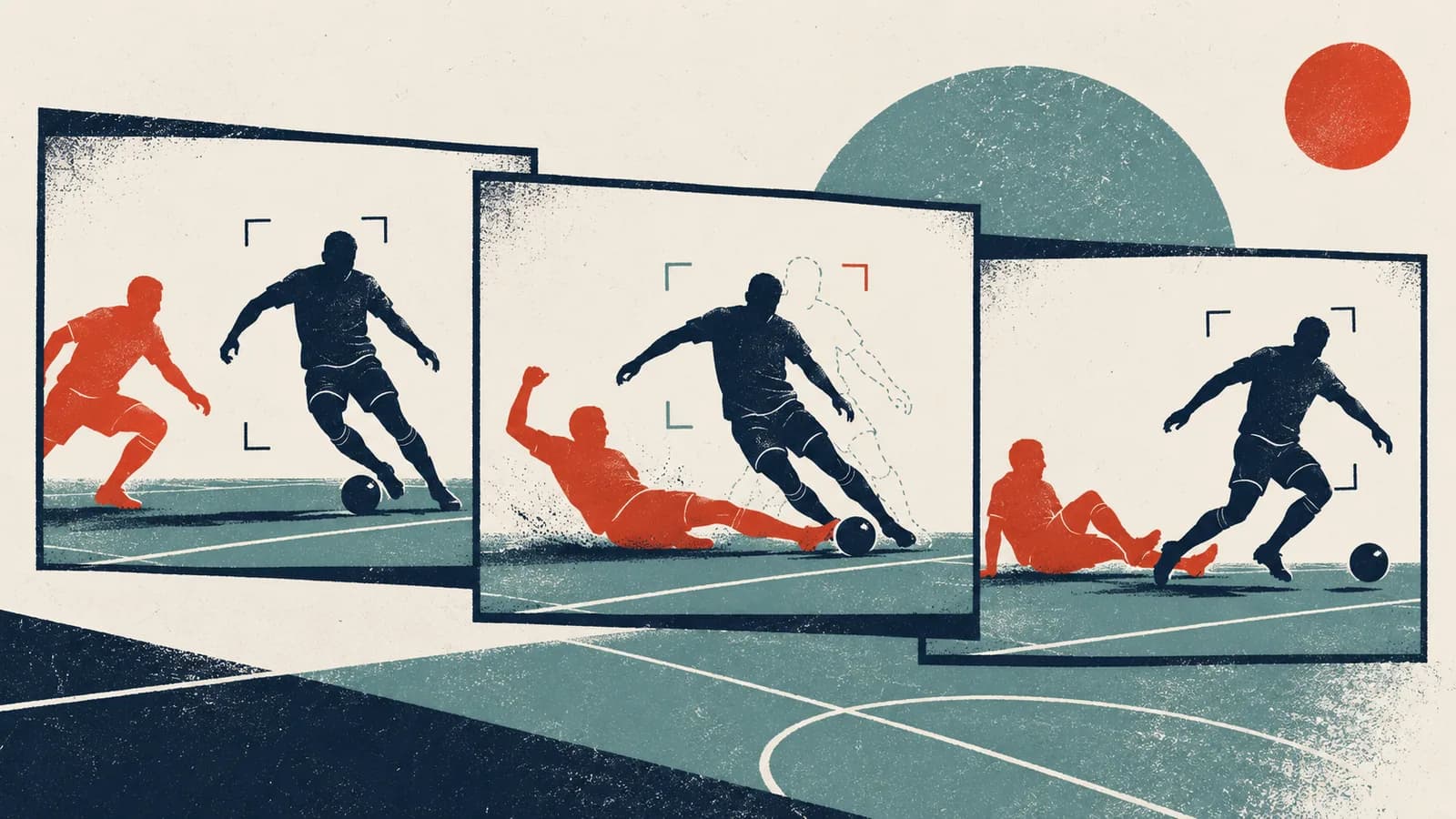
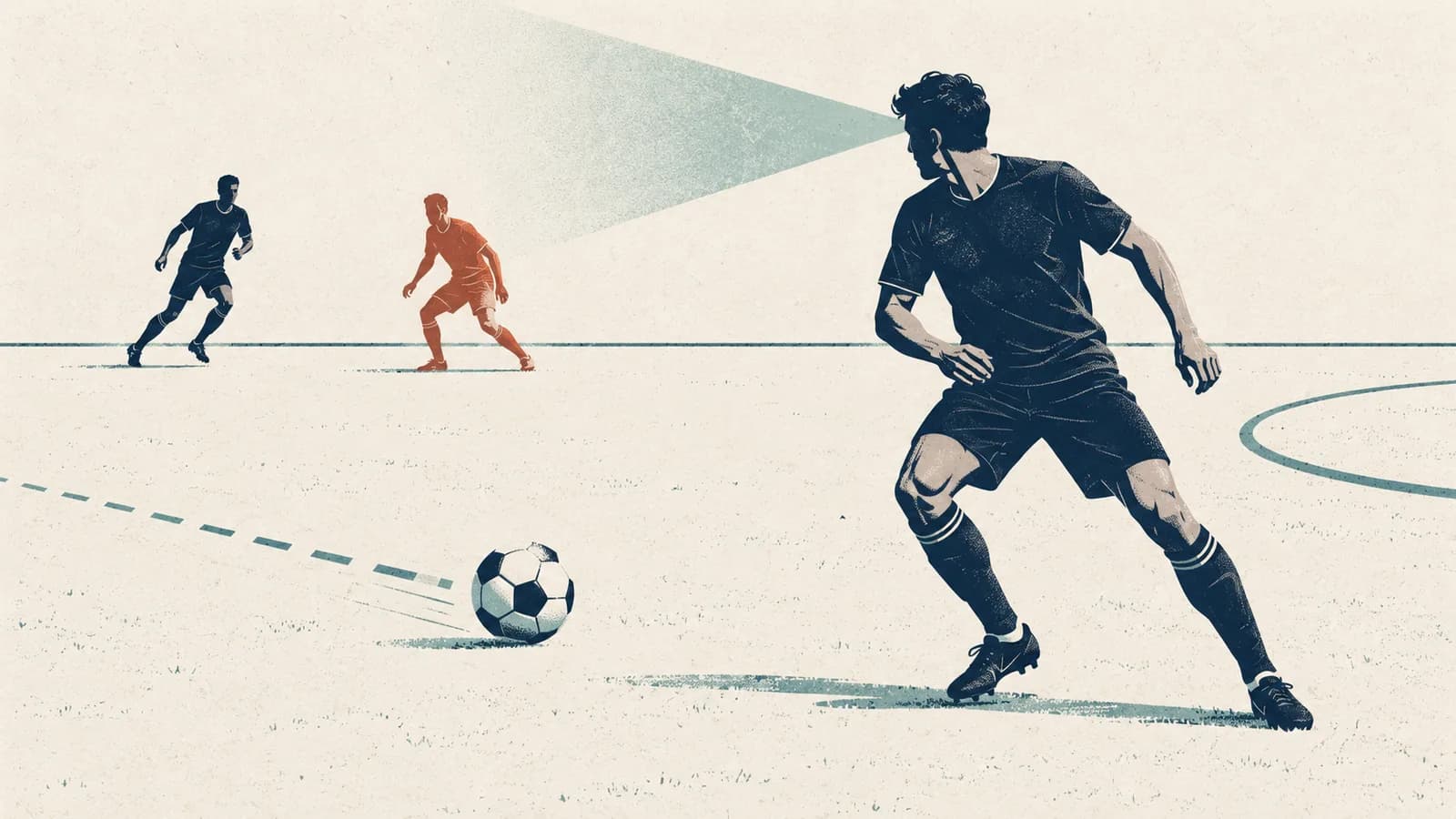
Imagine a midfielder waiting for a pass from a centre-back. A glance over the shoulder reveals a marker; another checks a teammate’s position. By the time the ball arrives, turning may already look sensible or disastrous. This is an illustrative situation, not a sequence from a particular match. Its interest lies in the work that happens before the highlight begins.
A 2020 study led by Geir Jordet put that preparatory work under unusually close scrutiny. It offers evidence for scanning, but also a helpful antidote to the idea that football can be solved by asking everyone to swivel more enthusiastically.
References:[2] FIFA Talent Coach Programme: Developing central midfielders — Game-phases (1 July 2026)[1] Frontiers in Psychology · 11:553813
Counting the look, not reading the mind
The researchers analysed 9,574 individual ball possessions involving 27 male professionals from one English Premier League club during the 2017–18 season. Their 21 home matches comprised 13 Premier League games, six Europa League games and two League Cup games. That distinction matters: this was a Premier League club sample, not 21 Premier League fixtures or a survey of the division.
They used dedicated camera recordings and player-centred close-ups, alongside a synchronised wider view. Trained observers counted head movements that temporarily directed a player’s face away from the ball. Scan frequency was measured over the final ten seconds of the team’s possession before reception, with shorter windows when possession had only recently begun and a separate convention for restarts.
This is an observable behaviour with a plausible informational purpose. It is not a direct record of what the eyes fixated on, what the player understood or whether the information was useful. A head movement is evidence of a head movement. The mind remains inconveniently unavailable for inspection.
Reliability was checked by double-coding 784 possessions, 8.2% of the total. The overall intraclass correlation for scan counts was 0.979, indicating strong agreement between observers. Agreement makes a measurement more dependable; it does not make its interpretation infallible.
References:[1] Frontiers in Psychology · 11:553813
The result is useful precisely because it is modest
Central midfielders and central defenders scanned more frequently than forwards. Players also scanned less under tight pressure and in some peripheral or advanced areas. The temptation is to arrange these findings into a league table of intelligence. The paper instead points towards the demands of the situation: different jobs create different opportunities and needs to look.
The more interesting test concerned passing. Repeated observations from the same player are not independent pieces of evidence, so the authors used a hierarchical Bayesian model. In plain terms, it allowed players different baselines and different scanning associations, while borrowing information across the group when an individual supplied fewer observations.
They also estimated pass difficulty from contextual features using a random forest, a collection of decision trees, and included that estimate in the passing model. A short return pass and a difficult progressive ball should not arrive at the statistical tribunal wearing identical name tags.
After that adjustment, higher scanning frequency was associated with a higher probability of completing a pass. The authors describe the relationship as small: technical ability and passing context played much larger roles. They did not establish that adding a particular number of shoulder checks produces a fixed percentage improvement. Nor did they show that completion alone captures the value of a pass.
References:[1] Frontiers in Psychology · 11:553813
Why the coaching context matters
FIFA’s recent session gives the research a practical setting. Its midfielders must recognise space and use changing passing options as the practice expands. That guidance illustrates a contemporary coaching concern; it is not a trial validating Jordet’s findings.
Our interpretation is that scanning deserves to be discussed alongside the next action. Did the player identify pressure, shape the reception accordingly and use an available option? A look followed by the same predetermined pass may be less informative than a well-timed glance that changes the decision. The study counted frequency, rather than settling this question about informational quality.
There is also a tactical problem hidden inside an individual habit. Teammates must create options worth noticing. Asking a midfielder to gather more information while nobody offers a passing angle is rather like improving the reception on a radio that has nothing to broadcast. Scanning can prepare a decision; it cannot manufacture the supporting movement.
References:[2] FIFA Talent Coach Programme: Developing central midfielders — Game-phases (1 July 2026)[1] Frontiers in Psychology · 11:553813
The limits travel with the finding
The sample came from one possession-oriented club, entirely at home, in a historical season. More than nine thousand possessions sound reassuring, but they do not become nine thousand independent teams. Different tactical systems, opponents, age groups and away environments may produce different relationships.
This was observational research. Players were not randomly assigned to scan more, and the model cannot remove every difference in skill, pressure or circumstance. An association is grounds for asking a better training question, not proof that a scanning intervention caused improved passing. The paper also acknowledges manual measurement error and the limitations of its ten-second window.
Transparency matters here too. Arsenal partly funded the research, and several authors disclosed affiliations or employment with the club. Those links do not invalidate the study, but they belong beside its conclusions. The underlying data are available on request to the lead author; we have reviewed the paper, not independently reproduced its analysis.
References:[1] Frontiers in Psychology · 11:553813
Watch the seconds before the useful bit
For a reader watching football, the next experiment is an attention exercise rather than a player ranking: where the camera permits, follow the receiver before the pass arrives. Notice the pressure, the timing of the look and the first action. Keep the unseen moments unseen. A broadcast cut or a highlights edit can remove precisely the interval this study measured.
For Sensible Stats, this is a research question rather than a new forecast input. A defensible measure would need consistent observation windows, explicit visibility rules and evaluation beyond the club in which it was developed. We have no basis here for assigning current players a scanning score or adjusting match probabilities.
The useful conclusion is smaller and more durable. Preparation is part of technique, and context decides how much preparation is possible. The first touch may earn the applause. The little act of reconnaissance beforehand deserves some attention too, even if it remains a poor candidate for a commemorative statue.
References:[1] Frontiers in Psychology · 11:553813
Sources and research status
- Scanning, Contextual Factors, and Association With Performance in English Premier League Footballers: An Investigation Across a Season
Geir Jordet, Karl Marius Aksum, Daniel N. Pedersen, Anup Walvekar, Arjav Trivedi, Alan McCall, Andreas Ivarsson and David Priestley · Frontiers in Psychology · 11:553813 · · Peer reviewed
- FIFA Talent Coach Programme: Developing central midfielders — Game-phases (1 July 2026)
Research findings are attributed to the sources above. Illustrative examples, proposed evaluations and interpretations are Sensible Stats analysis.