By Miles March · Published · 6 min read
In this article
A goalkeeper can become the final employee in a very busy organisation. Several people have already had a difficult afternoon. Then a ball arrives above a crowd and the entire business briefly depends on his hands. The resulting mistake gets a name. The preceding work tends to remain anonymous.
Tottenham won 2–0 at Chelsea on Saturday 24 October. The opening goal was a Mike Penders own goal; Mathys Tel added the second after Cole Palmer’s dismissal. This is a narrow study of two sequences in Chelsea’s official extended highlights, not a full-match viewing. Its question is deliberately smaller than who deserved to win: what was the defender’s next task, and how did the attacker change it?
References:[1] Chelsea FC · official video[2] Chelsea FC: Match report: Chelsea 0–2 Tottenham Hotspur
The corner asks for a clearance, not a verdict
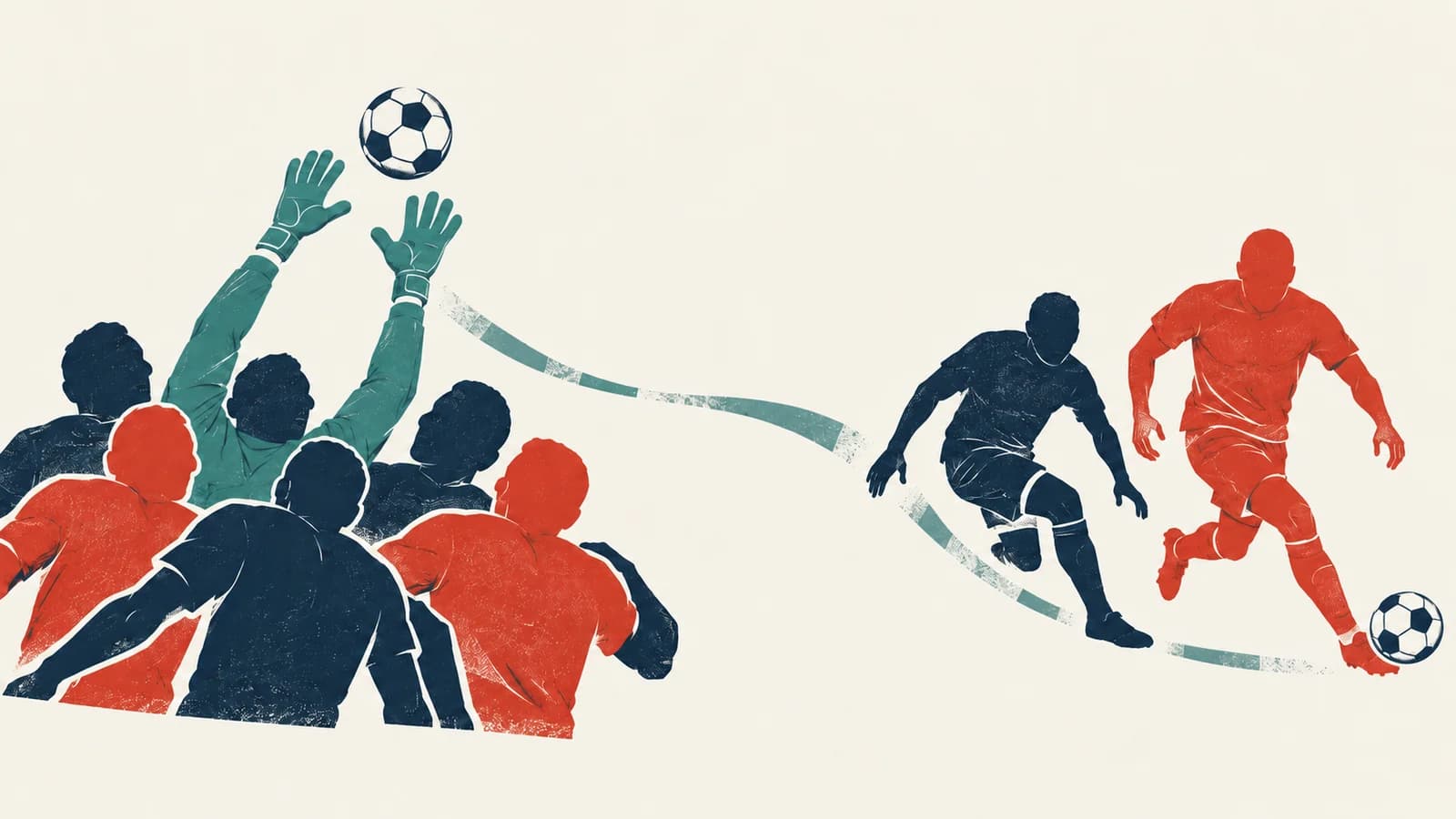
Start at 6:48 in the video. The delivery is arriving in a crowded goalmouth, with Penders off his line to intervene. White shirts and blue shirts occupy the space around him. This is an aerial problem with traffic. Reaching the ball is only part of it; the contact must also take it somewhere safe.
The close replay around 7:07–7:09 makes the distinction uncomfortable. Penders raises his hands among the bodies, and the ball ends up travelling towards his own goal. Chelsea’s report identifies Jan Paul van Hecke as the player applying pressure and records the own goal in the 77th minute. Those identities and the match minute come from the report; the crowding and the goalkeeper’s intervention are visible in the selected frames.
An own goal is a result category. It does not describe the task well enough to explain it. Here the relevant chain is delivery, crowded intervention, direction of clearance. An attacker can make the intervention less comfortable without providing the scoring touch. That does not establish a rehearsed routine or prove that contact caused the mistake. It identifies what to inspect before turning the goalkeeper into an entire tactical explanation.
For the defence, bodies near the goalkeeper are not automatically protection. A nearby player may be contesting an opponent, watching the flight or trying to recover towards the line. A still image cannot settle every responsibility. The useful question is whether the attempted clearance ends the immediate danger. In this incident it does not. The scoreboard is quite efficient at recording that part.
References:[1] Chelsea FC · official video[2] Chelsea FC: Match report: Chelsea 0–2 Tottenham Hotspur
Tel changes the job while carrying the ball
Now go to 7:50–8:02. This time the ball is on the ground and the attack develops through a carry. Around 7:54, Tel is advancing with a Chelsea defender pursuing him. By 7:58, the wider view shows him moving inward, with another blue shirt ahead and teammates offering other locations for the attack. He has not simply arrived at an empty goal.
The defensive response matters. One player is trying to recover alongside or behind the runner; another is positioned in front of his route. Tel continues towards the central shooting area rather than keeping the attack confined to the flank. The selected frame around 8:00 precedes the finish; by 8:02 Penders is down and the score graphic reads 0–2. The official report dates Tel’s goal to the 87th minute. Opta’s account describes the low finish from range.
The change of task is the mechanism to watch. A defender following the run must keep recovering. The player ahead must deal with the runner’s next direction while remaining able to challenge a shot. As the carry turns inward, the problem is no longer just staying between a wide attacker and the goal line. The route towards a shooting position becomes relevant.
There are still defenders involved, and a shot could still be stopped. The goal does not prove that retreating was intrinsically wrong, or tell us which alternative would have succeeded. Nor can the edited sequence establish an instruction from either manager. What it does show is an attacker changing the location and nature of the next defensive action. The job description has been revised during the shift.
References:[1] Chelsea FC · official video[2] Chelsea FC: Match report: Chelsea 0–2 Tottenham Hotspur[3] Patric Ridge / Opta Analyst: Chelsea 0–2 Tottenham stats
The dismissal belongs between the goals
The chronology prevents a convenient mistake. Penders’ own goal came at 77 minutes. Palmer’s second yellow followed at 80. Tel scored at 87. The opener therefore cannot be explained by Chelsea having ten players. The later carry occurred with Chelsea both behind and a player short.
That is context, not a complete causal account. We have not measured how much space the dismissal created, and the camera does not give us every player throughout the move. It would be equally careless to erase the red card or to make it responsible for every subsequent metre of grass.
There is counter-evidence to a story of universal defensive helplessness, too. Chelsea’s official account records earlier saves by Penders against Omar Marmoush and Tel, and saves by Antonin Kinsky at the other end. These are attributed reported events here, not additional sequences we claim to have reconstructed. They matter because successful interventions belong in the assessment, even when the final edit and the final result encourage everyone to remember the failure.
References:[2] Chelsea FC: Match report: Chelsea 0–2 Tottenham Hotspur[1] Chelsea FC · official video
Watch the task before the outcome
Our earlier pitch-control review separated being near space from being able to influence it in time. This is a related viewing habit, not a calculation of that model. At the corner, proximity to the dropping ball does not settle the clearance. During the carry, a defender’s presence ahead of Tel does not settle the next change of direction.
On the next replay, pause before the decisive action. Ask what the nearest defender or goalkeeper must do next. Track how the attacker changes that task, then check the response and its outcome. Keep the score and numerical balance beside the observation. Keep the interventions that work, too. A collection containing only goals has already dismissed a considerable number of witnesses.
This pair of sequences cannot rank Chelsea’s defence, estimate a pressing rate or supply a new forecasting input. It can make the analysis more specific. One goal involves the direction of a crowded aerial intervention; the other follows a carry that moves the threat inward. Both finish in the same column. The work required to prevent them was different.
References:[1] Chelsea FC · official video[4] Sensible Stats: The grass is available. Getting there is another matter.
Sources and evidence
- Extended: Chelsea 0-2 Spurs
Chelsea Football Club · Chelsea FC · official video · · Official video
- Chelsea FC: Match report: Chelsea 0–2 Tottenham Hotspur, 24 October 2026
- Patric Ridge / Opta Analyst: Chelsea 0–2 Tottenham stats, 24 October 2026
- Sensible Stats: The grass is available. Getting there is another matter., Elias Vale, 15 October 2026
Match facts and attributed observations come from the sources above. Tactical interpretations are Sensible Stats analysis.
Video evidence and viewing scope
Extended: Chelsea 0-2 Spurs · Chelsea Football Club · Extended highlights · Accessed
- Clip 06:48–06:51; close replay 07:07–07:09 · Match 77 (official report; not a visible match clock): Direct decoded frames: crowded goalmouth, goalkeeper steps out and raises hands; close replay shows ball then travelling back towards own goal. Score changes to 0–1. Penders identity, van Hecke pressure and own-goal attribution cross-checked with official report. No foul or intended routine inferred.
- Clip 07:50–08:02; checked frames 07:54, 07:58, 08:00, 08:02 · Match 87 (official report; not a visible match clock): Direct decoded frames: white-shirted carrier advances with blue pursuer, moves inward towards another blue defender ahead, with supporting white shirts also visible; subsequent frame shows goalkeeper down and 0–2. Tel identity and minute from official report; low strike from range corroborated by Opta. No measured distances or full defensive shape inferred.