By Elias Vale · Published · 6 min read
In this article
Thierno Barry's goal against Hull on Sunday began with a pass that belonged to the other team. Sorba Thomas lost it, Kiernan Dewsbury-Hall intervened, and Barry went through to score. The Premier League's report records the sequence in the 68th minute of a 2–2 draw on 11 October. A defensive arrangement had acquired a new job rather suddenly.
Tuesday's Weekend Study asked whether defenders were prepared for the next action, rather than simply present. This week's research supplies a related question: what does it mean to control space? Football is full of apparently available grass. Much of it is available in the sense that the moon is available: plainly visible, somewhat inconvenient to reach.
References:[2] Premier League: Hull City v Everton[3] Sensible Stats: The defence was still facing yesterday
The nearest player is not the whole answer
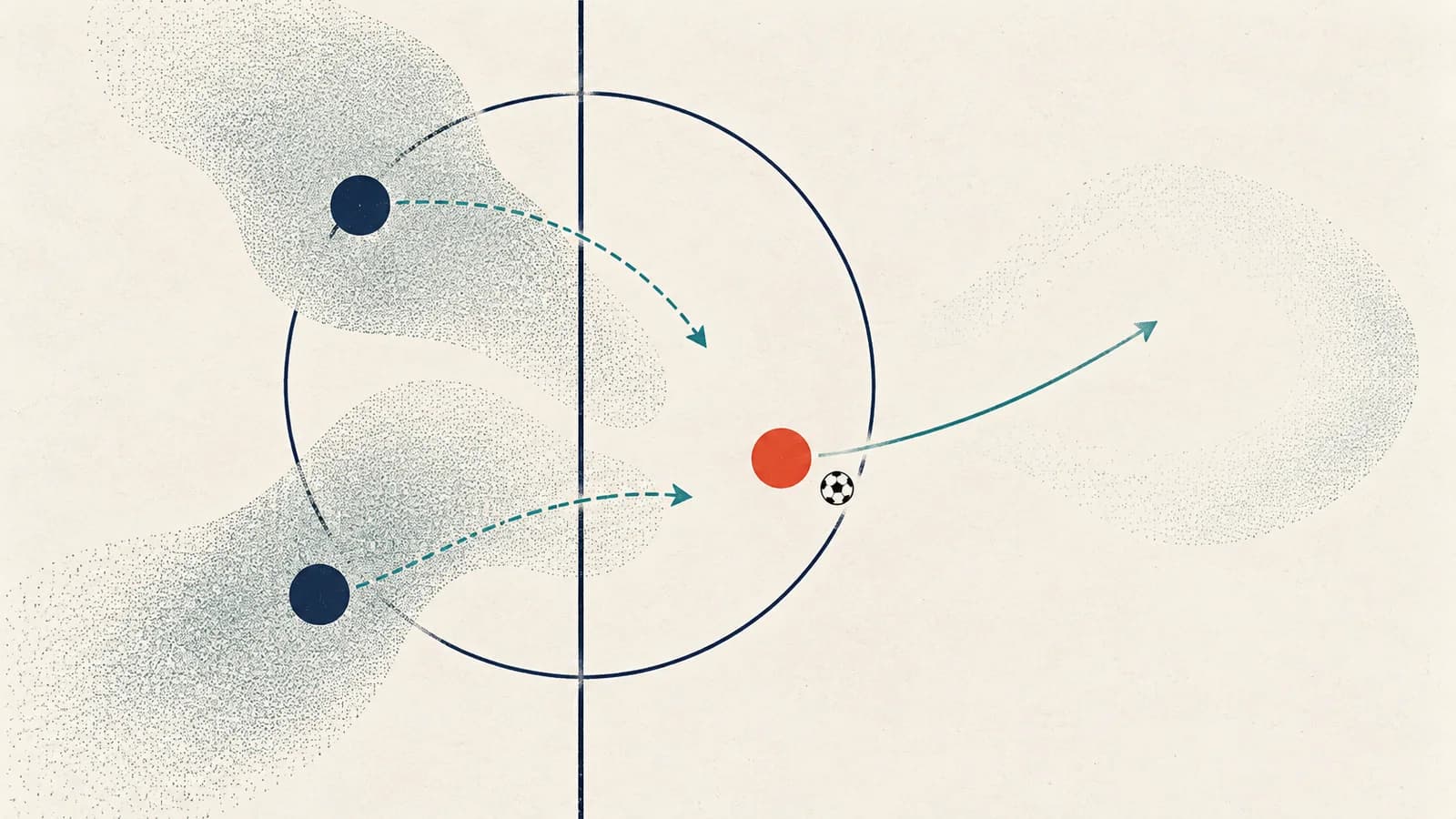
Imagine a hypothetical pass into a pocket between two defenders. One is closer but moving away. The other is farther away but already accelerating towards it. A still image invites us to award the territory to the nearest shirt. A useful explanation has to ask what happens while the ball travels. Distance is part of the problem; time changes its meaning.
Florian Martens, Uwe Dick and Ulf Brefeld's peer-reviewed 2021 paper, Space and Control in Soccer, studies this using tracking and event data from 54 Bundesliga matches in 2017/18. Its movement models learn where individual players reach from different initial speeds and directions. Those influence estimates underpin pitch control; a separate pitch-value measure helps distinguish useful territory from merely occupied territory.
Think of the difference as ownership and usefulness. Being able to reach a harmless patch beside your own goal does not make it as valuable to an attack as an opening nearer the opponent's goal. Our reading is that space deserves two questions before it receives a colour: who can influence it, and what could it enable? A heatmap that answers only the first can still be extremely handsome.
References:[1] Frontiers in Sports and Active Living · Volume 3, article 676179
What the test actually tested
The paper's possession classifier used 5,277 phases containing at least three passes; 5.5% ended in a shot. It repeatedly split those possessions randomly, 80% for training and 20% for evaluation, and assessed discrimination using AUC: how well the model ranks shot-ending possessions above the others across possible classification thresholds. The movement-based space-quality approach performed better than the comparison approach. That endpoint is a shot, not a goal, and the split is not a later-season test.
This distinction is the useful bit of statistical housekeeping. A method can separate two classes in historical data without giving us a dependable probability for next Saturday. The groups may share teams, players and tactical habits. A stronger practical question would be whether the method retains its usefulness on later matches, unfamiliar opponents and changing personnel. We would ask for that evidence before promoting a diagnostic into a forecasting feature.
There is another modest but important separation. A shot-ending possession is an outcome label. It does not certify every pass within that possession as a good decision. An attack may survive an unnecessary detour. Another may find a promising opening and then meet a poor touch. The proposed metric is a way to examine an attack, not permission to stop examining it.
References:[1] Frontiers in Sports and Active Living · Volume 3, article 676179
Back to the turnover, without a borrowed certainty
Barry's break gives the question a current setting, not a fresh experiment. The official report identifies the intercepted pass and the subsequent finish. Our earlier highlights study compared that transition with a recycled delivery and Hull's later equaliser. Here we are referring back to that published viewing record; we have not produced new tracking coordinates or run this paper's model on the game.
The useful connection is a change of task. Before a turnover, a defender's position may make sense relative to their team's possession. Afterwards, the important space may lie somewhere else, with less time to reach it. This is our interpretation of what to investigate. It cannot tell us what any Hull player intended, saw or would have done with an extra second.
Nor does a visible option necessarily explain the finish. A supporting player can occupy an inviting pocket without supplying the decisive action. We need to trace the pass actually played before crediting the space beside it. A pitch-control analysis should make us more demanding about evidence, not provide a scientific-sounding substitute for watching the ball and the players. The diagram is a witness with a restricted field of view.
References:[2] Premier League: Hull City v Everton[3] Sensible Stats: The defence was still facing yesterday[1] Frontiers in Sports and Active Living · Volume 3, article 676179
A viewing question that can survive a failed attack
For the next study, start before the outcome is known. When a pass is released, ask which player is moving towards the likely receiving space and which must first turn. Then ask whether the receiving area offers a useful next action. Keep attacks that fizzle out as well as the ones that end in goals. Otherwise the highlights editor has already selected the answer.
Record the score and time, pressure on the passer, what the camera actually reveals and whether the next action is interrupted. Where a player disappears from view, write unobservable. Do not turn a television crop into a census. This is a proposed observation framework, not an annotation method validated by the paper, and any comparisons would need consistent definitions and enough visible opportunities.
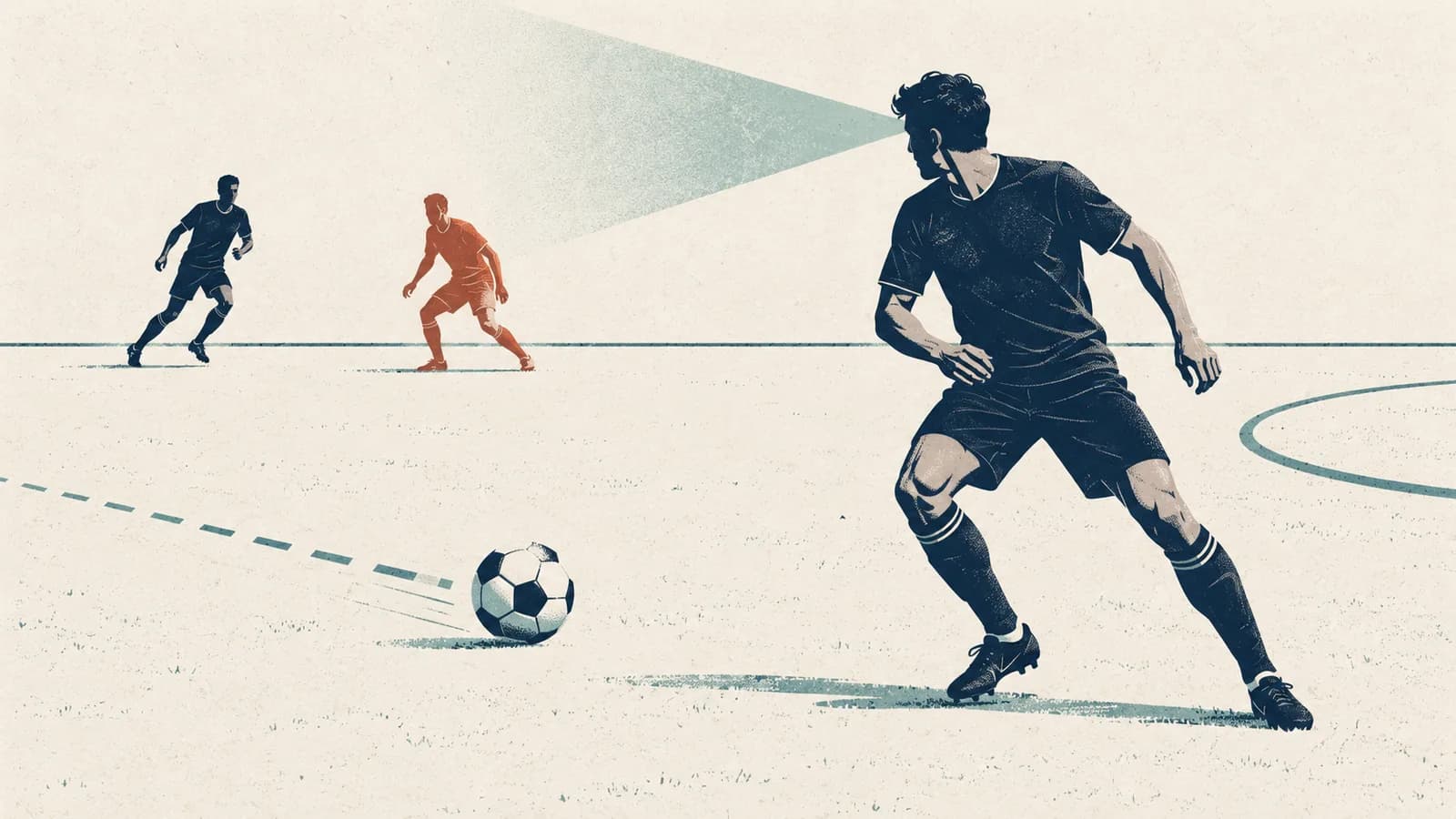
It also refines our earlier scanning question. Looking before receiving concerns information; reaching useful space concerns movement and timing. The two may interact, but one is not a measurement of the other. A player can look and remain poorly placed. A player can arrive well and choose badly. The point of learning across articles is to sharpen the questions, rather than merge every promising idea into a single theory of clever football.
References:[1] Frontiers in Sports and Active Living · Volume 3, article 676179[3] Sensible Stats: The defence was still facing yesterday[4] Sensible Stats: Before the first touch
Useful territory, with the paperwork attached
The underlying DFL data are restricted, so we have reviewed the full paper without reproducing its calculations. Historical evidence belongs in its historical setting. No measured pitch-control score for Hull, Everton or any current Premier League player follows from this review, and no Sensible Stats forecast changes with it.
What does travel is a better habit of attention. Separate the space a player occupies from the space they can influence in time; then separate that influence from the usefulness of the location. On a future replay, a defender's recovery run may be the first thing worth following. The empty patch can wait. It has been doing that all afternoon.
References:[1] Frontiers in Sports and Active Living · Volume 3, article 676179
Sources and research status
- Space and Control in Soccer
Florian Martens, Uwe Dick and Ulf Brefeld · Frontiers in Sports and Active Living · Volume 3, article 676179 · · Peer reviewed
- Premier League: Hull City v Everton, official report, 11 October 2026
- Sensible Stats: The defence was still facing yesterday, Miles March, 13 October 2026
- Sensible Stats: Before the first touch, a little reconnaissance, Elias Vale, 8 October 2026
Research findings are attributed to the sources above. Illustrative examples, proposed evaluations and interpretations are Sensible Stats analysis.