By Elias Vale · Published · 6 min read
In this article
Oli McBurnie gave Hull City the lead from the penalty spot against Brentford on Sunday 25 October. Brentford’s official report records a loose pass from Caoimhín Kelleher, a foul on Tim Iroegbunam and McBurnie’s conversion before Dango Ouattara levelled in a 1–1 draw. For the scoresheet, the essential work was finished. For an analyst, one successful penalty leaves several questions politely unanswered.
We know the outcome. The report does not tell us McBurnie’s intended target, his normal spread of shots around it or whether a different target would serve him better over repeated attempts. Those are different claims. A March 2026 paper by Thomas Bull Andersen and Jeppe Bjerregaard Carstensen makes that distinction its central problem: choosing where to aim means allowing for where the ball might actually go.
References:[2] Brentford FC: Hull 1 Brentford 1: Ouattara earns Bees away point[1] Proceedings of the Institution of Mechanical Engineers, Part P: Journal of Sports Engineering and Technology · OnlineFirst
A target is a plan, not a postcode
The study combines 4,299 Danish youth shootout penalties with 1,060 laboratory kicks: 20 apiece from 53 academy players from under-15 to under-19 groups. It uses shot spread and a goal-zone scoring map in Monte Carlo simulations. The model favours less adventurous targets for more variable kicking; changing the spread’s orientation also changes the preferred aim.
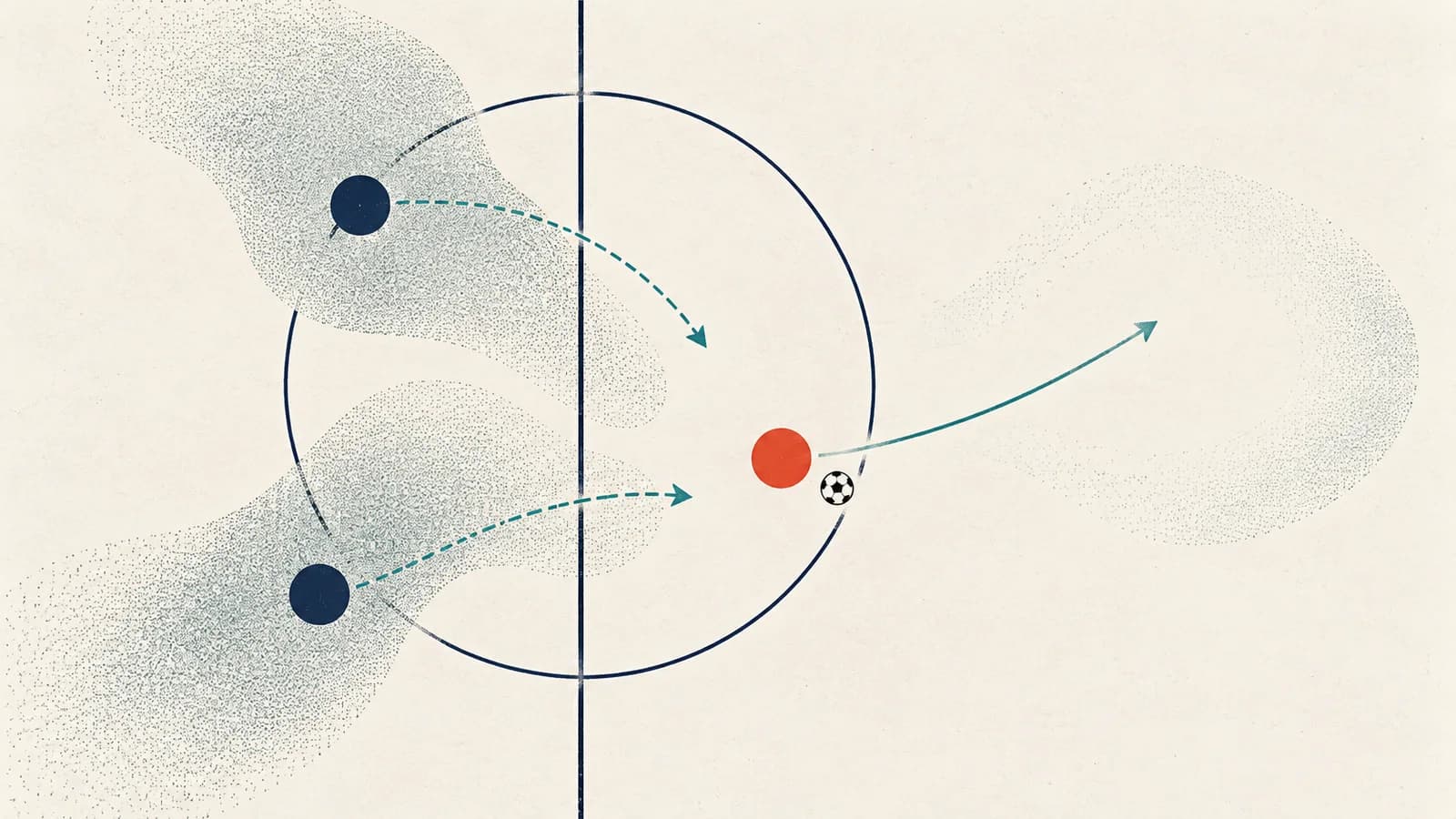
The plain-language idea is more interesting than the machinery’s name. Imagine moving a target while the player’s usual errors move with it. Near a boundary, part of that spread may leave the goal. Further inside, more attempts may remain available for the goalkeeper to save. Neither choice can be assessed by looking only at the shot that lands exactly where intended.
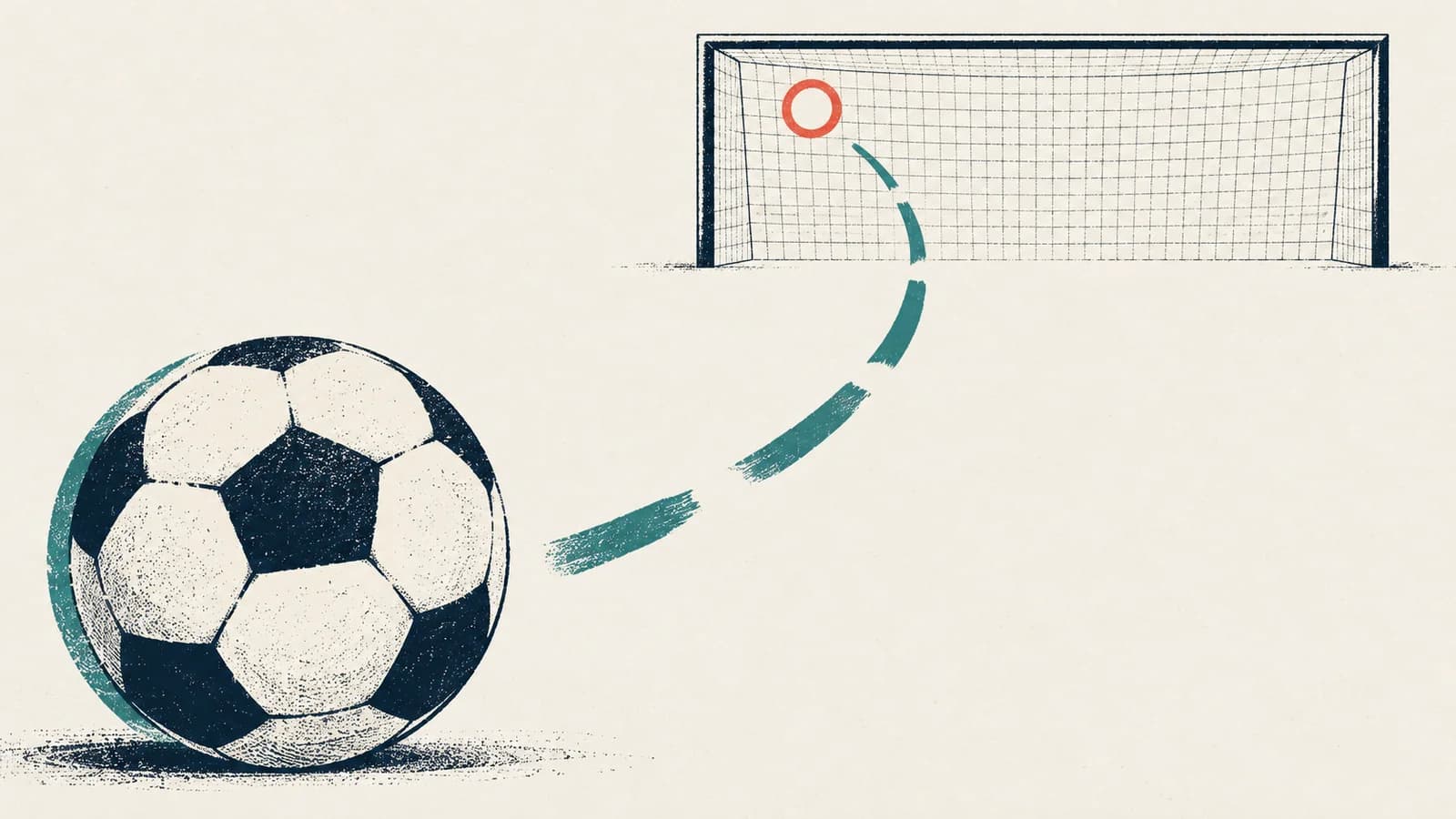
Aiming and landing therefore belong in separate columns. A spectacular finish supplies evidence about an outcome. Recommending the same target supplies a plan for future attempts. The second claim needs information the first does not contain. The top corner has impeccable presentation. Its arrangements for accepting imperfect deliveries are less generous.
Keep the misses in the room
The paper’s initial 15-zone scoring map excludes off-target shots; its simulations then assign zero scoring probability to simulated misses. That distinction is essential. A chart of shots that reach the goal asks a conditional question. A choice of aiming point must also account for attempts that never give the goalkeeper a decision.
This is our practical reading: start the denominator before the ball leaves the boot. Include shots over the bar, outside the post and against the frame when assessing an aiming strategy. Do not quietly reduce the question to which on-target shots were hardest to stop. A dataset can become very complimentary once the embarrassing rows have been shown outside.
The same care applies to a claim that one location is safer. Safer from a save and safer from a miss are separate propositions. A useful evaluation needs both, along with uncertainty about how often each occurs. A tidy ranking of locations can conceal an untidy change in the population being counted.
The laboratory is not the MKM Stadium
The laboratory used a rolling ball and one central target at a height of 1.6 metres. The shootout observations are from youth football, collected since 2021. This is not a Premier League trial of players switching targets. Its preferred locations are simulation outputs, not a demonstrated improvement in adult match conversion.
That leaves a productive question rather than a dismissal. Does a player’s measured error pattern remain similar when the target moves, when a stationary ball replaces the rolling one, or when a goalkeeper is involved? Those conditions deserve testing before a model’s preferred spot becomes an instruction. Repeatable laboratory measurement and transferable coaching advice are different achievements.
McBurnie’s successful kick cannot settle any of that. Nor should a miss next weekend be treated as a refutation of the entire framework. One event is a poor audition for a theory about repeated execution. The study suggests what to measure; the current match supplies a reason to care. Neither needs to impersonate the other.
References:[1] Proceedings of the Institution of Mechanical Engineers, Part P: Journal of Sports Engineering and Technology · OnlineFirst[2] Brentford FC: Hull 1 Brentford 1: Ouattara earns Bees away point
The goalkeeper has not been consulted
Our next question concerns the opponent. A proposed target must still make sense against a goalkeeper who can prepare, react and sometimes learn. A recommendation that performs well against one assumed scoring map may behave differently when the people in the goal change their behaviour.
That is a question for further evaluation, not an effect estimated here for Kelleher or McBurnie. It also prevents an easy piece of advice from becoming a permanent address. We would want to compare targets under relevant goalkeeper responses, while keeping the taker’s execution errors in the calculation. More precision in the diagram does not remove uncertainty about the opponent.
Even the shape of error deserves caution. A player might be more consistent across one direction than another. Describing that pattern could help design a test; turning it into a character judgement would not. An ellipse is a description of observed variation. It has not interviewed the player about courage.
What we should learn from the next penalty
Our pitch-control review separated accessible space from useful space. The connection here is a viewing question, not a shared measurement: a theoretically attractive destination only helps if the player can execute the action that reaches it. For penalties, that means recording the intended target separately from the observed finish whenever the target is genuinely known.
A sensible next study would preserve every attempt, distinguish training from matches and in-match penalties from shootouts, and test a proposed rule on later attempts rather than the sample used to choose it. Target intention should be marked unknown when the evidence cannot establish it. A broadcast finish is not an admission form completed by the taker’s brain.
McBurnie scored, and that fact needs no statistical rescue. Learning how he should aim next time requires a different body of evidence. The useful advance is not a new command to aim high or aim low. It is a better question: which target remains useful when the player brings his actual execution, rather than his imaginary perfect kick?
References:[1] Proceedings of the Institution of Mechanical Engineers, Part P: Journal of Sports Engineering and Technology · OnlineFirst[3] Sensible Stats: The grass is available. Getting there is another matter.[2] Brentford FC: Hull 1 Brentford 1: Ouattara earns Bees away point
Sources and research status
- Where to aim in soccer penalty kicks: Balancing strategy and execution
Thomas Bull Andersen and Jeppe Bjerregaard Carstensen · Proceedings of the Institution of Mechanical Engineers, Part P: Journal of Sports Engineering and Technology · OnlineFirst · · Peer reviewed
- Brentford FC: Hull 1 Brentford 1: Ouattara earns Bees away point, 25 October 2026
- Sensible Stats: The grass is available. Getting there is another matter., Elias Vale, 15 October 2026
Research findings are attributed to the sources above. Illustrative examples, proposed evaluations and interpretations are Sensible Stats analysis.