By Elias Vale · Published · 6 min read
In this article
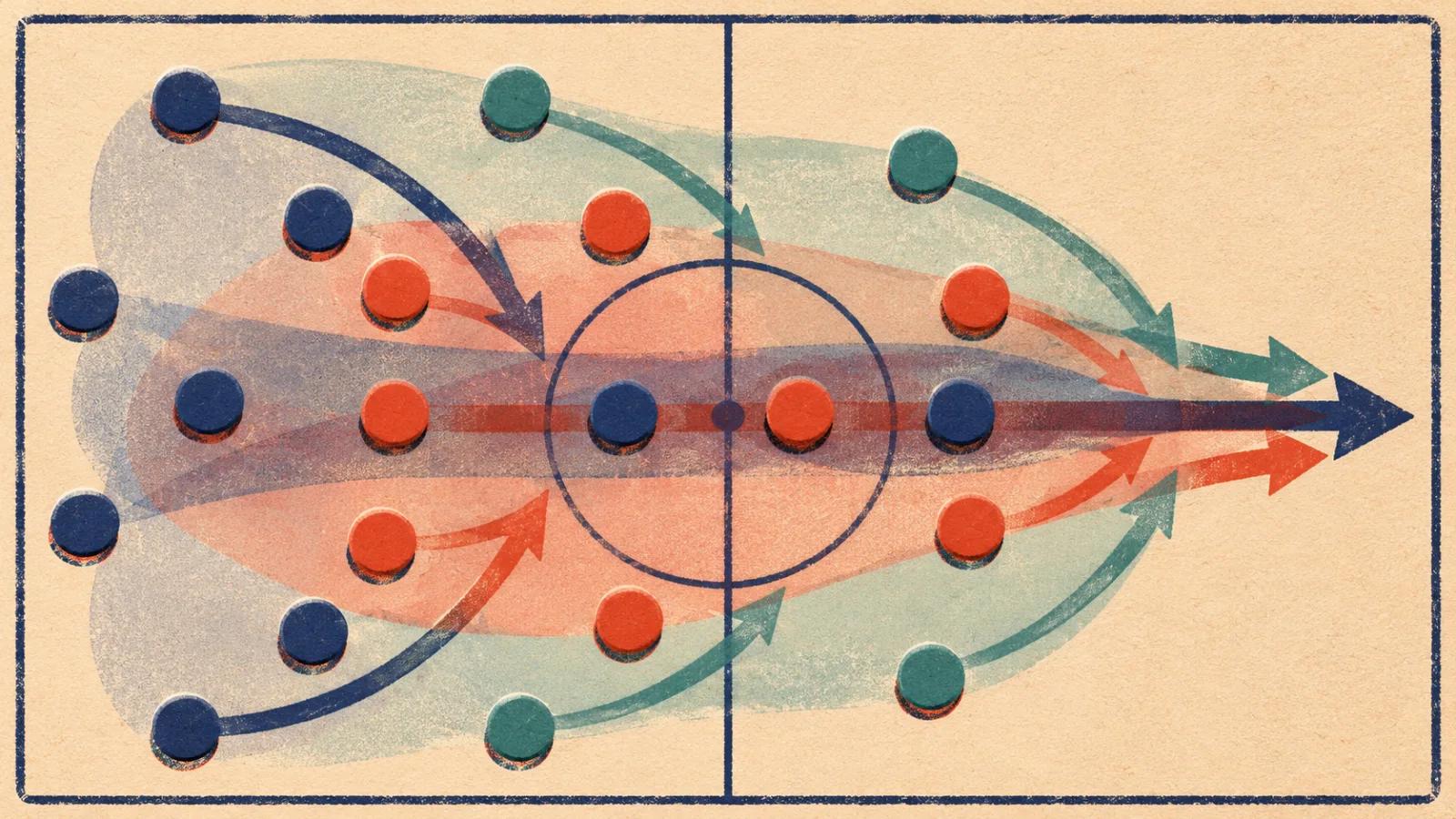
England led Spain 3–0 in Madrid on 15 November, then lost Elliot Anderson to a red card and held on to win 3–2. England Football’s report describes Lamine Yamal releasing Nico Williams to finish at the back post. It leaves a very ordinary coaching question amid the international drama. How do you rehearse the defender’s journey from a crowded centre towards a threat out wide?
Tuesday’s Weekend Study examined that decision in selected match passages. Here we turn to the practice ground. Imagine an exercise in which the wide outlet is so close that the defender can reach both jobs almost at once. It may produce an agreeable session. Whether it rehearses the problem you meant to solve deserves a separate look.
References:[3] England Football — Spain 2–3 England[5] Sensible Stats — The far side is still open
Choose the decision before the rectangle
A useful starting point is a 2019 study by Sigrid Olthof, Wouter Frencken and Koen Lemmink. Across the 2015–16 Dutch season, 280 players from 12 academy teams in under-13 to under-19 categories played official matches and smaller training games. The researchers used tracking data to compare spacing, including groups of neighbouring players. Comparing equally sized local groups helps distinguish changes in nearby support from the simple fact that a smaller team contains fewer people.
Their training formats were four, six or eight outfield players per side, each with a goalkeeper. Pitch dimensions aimed at about 320 square metres per player, counting both teams and the keepers. Four-a-side plus keepers therefore used 68 by 47 metres. That is the study’s setup, rather than a prescription for every team.
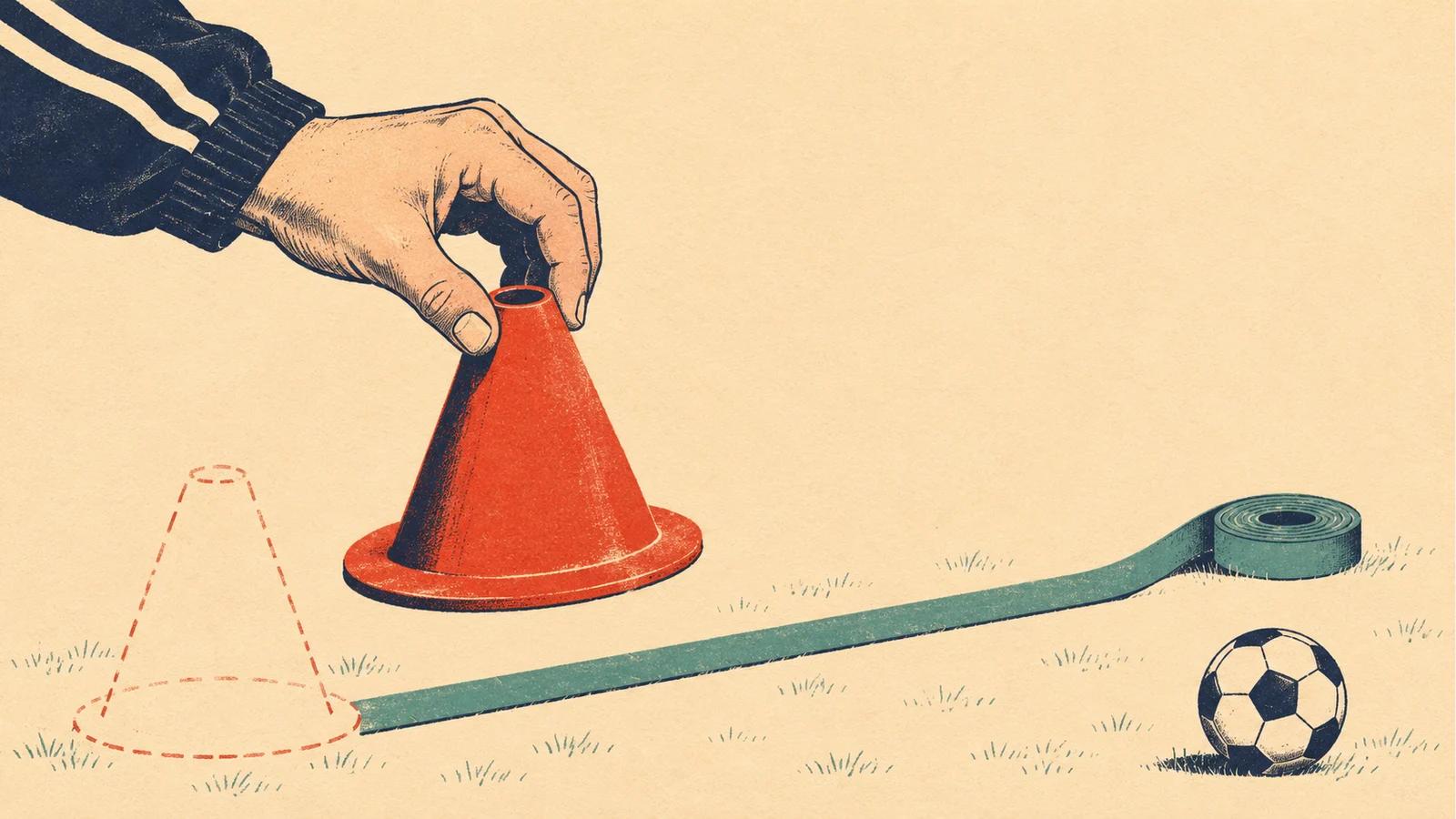
Why bother with the arithmetic? Imagine leaving the boundaries alone while doubling the number of players. The exercise still has the same name on the session plan, but the routes available to a receiver have changed. Counting players without measuring the space leaves one of the coaches out of the discussion. The cones rarely complain.
References:[1] Journal of Strength and Conditioning Research · 33(2), 523–530 · February 2019 issue
Similarity depends on where you look
The results depended on the unit compared. Whole teams occupied less space in small games than in matches. Neighbouring-player groups were often similar, but four-a-side plus keepers produced larger four-player interpersonal distances in the three younger categories. Failure to detect a difference elsewhere does not prove equivalence. This was a cross-sectional comparison, with coach-selected formats, rather than a trial of subsequent match improvement.
That matters when someone declares a practice realistic. Realistic for which job? A centre-back and the nearest supporting player may face a useful local problem while the team’s overall recovery structure remains different. Our pitch-control review asked who could reach useful space. Designing practice adds another question. Has the setup left that space available for anyone to use?
The current England example cannot validate the youth study. A dismissal, the score and a live opponent make a different setting. But it helps specify the task worth rehearsing. A defender deciding whether to leave the middle needs an exercise in which leaving has consequences, including a credible option behind them.
References:[1] Journal of Strength and Conditioning Research · 33(2), 523–530 · February 2019 issue[6] Sensible Stats — The grass is available. Getting there is another matter.[3] England Football — Spain 2–3 England
A wider pitch is a different assignment
The same researchers’ earlier experiment, published online in November 2017 and in a 2018 journal issue, compared four-a-side plus keepers on 40-by-30 and 68-by-47-metre pitches. Players spread out more and covered more distance at higher speeds on the larger version. Offside and restart arrangements also differed, so the comparison changed more than dimensions alone.
The trade-off is useful even without declaring a winner. Suppose the aim is repeated close control under immediate challenge. A tight game might be exactly what the coach wants. Suppose instead the aim is deciding when to step towards a distant receiver while protecting the centre. Check whether the exercise allows that choice to occur before judging how well the players make it.
For the armchair discussion, watch the first defender’s starting position and the route the pass opens. Being near a teammate and being able to help them are different observations. For the session plan, ask whether the receiver can escape the crowd at all. A beautifully compact exercise can answer a question nobody asked.
References:[2] Olthof[5] Sensible Stats — The far side is still open
Give the comparison something to count
For a coach working on wide releases and recovery, we propose an untested comparison within normal training. First, identify the precise decision with the players. Who leaves to challenge the wide receiver, and who protects the central route? Agree what counts as an attempted wide release and a reception before a defender can challenge. Count an attack from controlled possession until a goal, the ball going out or the opponent gaining control.
Next, compare the usual exercise with one wider version suited to the squad, keeping player numbers, rules and work periods the same. Alternate the order across sessions and rotate the roles. Let staff judge the space and workload they can accommodate. The research dimensions are reference points for scrutiny, not a distance everyone must adopt.
Finally, record every attempted wide release, whether it reaches a teammate before a challenge, and whether the attack ends with a central shot. Keep intercepted passes, misses and attacks without shots. Compare receptions per attempted release alongside central shots per attack. If one version never produces a wide attempt, record that absence. It may be failing to present the decision.
These counts test what the exercise presents today. To argue that players learn better from it would require later assessment under comparable conditions. A wider game could expose more escapes while also opening the middle. That is a coaching trade-off to inspect, rather than an improvement to announce.
References:[1] Journal of Strength and Conditioning Research · 33(2), 523–530 · February 2019 issue[2] Olthof
The next measurement should earn its place
There are newer ways to examine the same problem. A June 2026 preprint by Takuma Narizuka and colleagues uses 2023 Japanese league tracking data to estimate how quickly an opponent could reach the ball carrier. It makes arrival time an explicit quantity, although its simplified movement model leaves out body orientation and coordinated team behaviour.
Such methods invite better questions about the training comparison. They do not remove the need to define the decision, preserve unsuccessful attempts or mark an obscured player unknown. Start with a setup in which the choice can occur. Then inspect whether the player recognises it and what follows. The cone has already given its opinion. The players should get a turn.
References:[4] Narizuka[6] Sensible Stats — The grass is available. Getting there is another matter.
Sources and research status
- A Match-Derived Relative Pitch Area Facilitates the Tactical Representativeness of Small-Sided Games for the Official Soccer Match
Sigrid B. H. Olthof, Wouter G. P. Frencken and Koen A. P. M. Lemmink · Journal of Strength and Conditioning Research · 33(2), 523–530 · February 2019 issue · · Peer reviewed
- Olthof, Frencken and Lemmink — full published 2018 pitch-size experiment, online 10 November 2017, Journal of Sports Sciences 36(14), 1557–1563
- England Football — Spain 2–3 England, official match report, 15 November 2026
- Narizuka, Sakamoto, Yamamoto and Yamazaki — minimum-arrival-time pressure model, arXiv preprint v2, 11 July 2026
- Sensible Stats — The far side is still open, Miles March, 17 November 2026, selected-highlights study
- Sensible Stats — The grass is available. Getting there is another matter., Elias Vale, 15 October 2026
Research findings are attributed to the sources above. Illustrative examples, proposed evaluations and interpretations are Sensible Stats analysis.